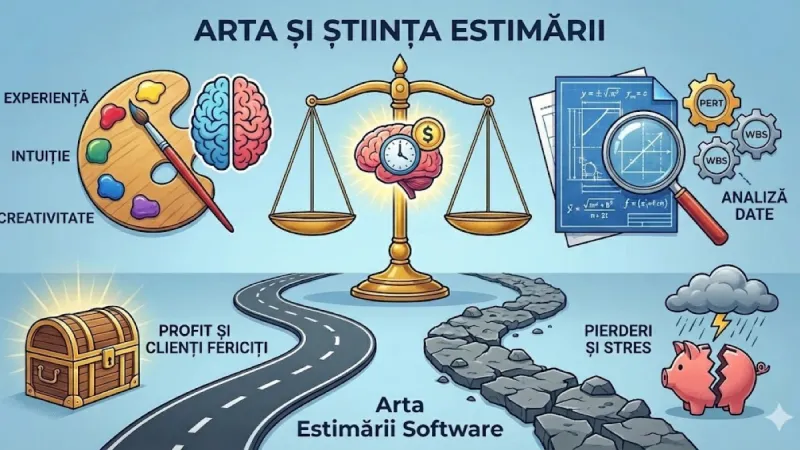
Over 66% of software projects exceed their estimated budget. We decipher the PERT, WBS, and bottom-up estimation methods that transform guesswork into exact science and protect you from costly surprises.
Estimating a software project is both an art and a science. International studies show that over 66 percent of software projects exceed their estimated budget, and approximately one-third exceed planned deadlines. These statistics are not just abstract figures. They represent sleepless nights, destroyed client relationships, lost money, and immense stress for everyone involved.
The secret to a good estimate lies in decomposition and realism. Before giving a price, you must break the project down into small, manageable components. Professional estimation using proven methodologies like Work Breakdown Structure, the PERT technique, and bottom-up estimation is not complicated or academic. It is the foundation of any successful project.
Project Decomposition: Work Breakdown Structure (WBS)
For a typical web application, you begin with the discovery and planning phase, which usually consumes between eight and ten percent of total hours. This includes requirements analysis, competitor study, technical architecture design, and writing functional specifications. It is the foundation upon which everything is built, and saving time here will cost you ten times more later.
Next is design, taking between ten and fifteen percent of the project. Here we talk about wireframes, visual design, interactive prototypes, and creating a consistent design system. Many developers ignore this phase or dramatically underestimate it, then find themselves having to redo half the interface because it doesn't meet client expectations.
The backend is the most substantial part, usually consuming between thirty and forty percent of the time. It includes the database, APIs, business logic, integrations with external services, and implementation of security measures. Here complexity can explode rapidly if you don't have a clear architecture from the start.
The frontend takes another twenty-five to thirty-five percent, covering application architecture, implementation of visual components, state management, API integration, and adaptation for different screen sizes. This is the phase where hidden "details" can double the estimated time: animations, micro-interactions, interface edge cases, cross-browser compatibility.
Testing and Quality Assurance (QA) deserve between ten and fifteen percent of the time, and deployment and documentation another five to ten percent. Many developers treat testing as an optional activity or compress it at the end when deadlines press. The result: bugs in production that cost ten times more to fix than if they had been caught in the testing phase.
The Three-Point Technique: PERT
The Three-Point Method is particularly useful for uncertain tasks or complex projects, helping teams consider optimal and pessimistic scenarios. For each task, you imagine three scenarios: the optimistic one, where everything goes perfectly; the realistic one, where things proceed normally; and the pessimistic one, where problems arise. The mathematical formula tells you to take the optimistic scenario plus four times the realistic scenario plus the pessimistic scenario, all divided by six. The result is a much more realistic estimate than a simple guess.
Let's take a concrete example. You need to implement an authentication system. Optimistically, if everything goes perfectly, it takes you eight hours. Realistically, with normal complexity, it takes you sixteen hours. Pessimistically, if unexpected problems arise with OAuth or testing on different browsers, it can reach thirty-two hours. Apply the formula, and you get approximately seventeen hours. But for safety, you round up to twenty hours, adding a buffer for potential surprises.
This method works because it forces the developer to think critically about what can go wrong. When you estimate optimistically, your brain automatically ignores all potential problems. PERT forces you to consider them and create an estimate that reflects reality, not hope.
Bottom-Up Estimation: Building from the Ground Up
This method involves estimating each individual task and aggregating them for a total. It is the most accurate method, but also the most time-consuming. For a "User Dashboard" feature, for example, you completely break down everything that dashboard means.
For the backend, you need to design the database schema, create API endpoints for each functionality, implement a caching layer for performance, write unit tests, and go through code review. Each of these activities has its own estimated time: four hours for the schema, fifteen hours for five endpoints at three hours each, six hours for caching, eight hours for tests, four hours for review and refinement. Backend subtotal: thirty-seven hours.
For the frontend, you need to create component architecture, build the dashboard layout, implement data visualizations, connect everything to the API, ensure responsive design, write tests, and do cross-browser testing. The subtotal reaches forty-three hours. Add integration, testing, and bug fixing, and you reach over one hundred hours just for a single complex feature.
The advantage of this method is that when the client tells you the budget is too high, you can show exactly where the hours are going and which components could be eliminated or simplified to reduce the cost. Complete transparency eliminates the perception that you are "pulling a number out of thin air."
Factors Complicating Estimation
Technical complexity can dramatically change the estimate. A simple CRUD project with standard interfaces and technologies you know well will take exactly as long as you estimate. But one with moderate business logic, multiple external API integrations, and a complex authentication system can take thirty to fifty percent longer. Projects with microservices architecture, real-time functionalities, or payment processing can double or triple the estimated time. And if you enter areas like artificial intelligence, big data processing, or blockchain, you can multiply the initial estimate by three or even four.
Team experience matters enormously. A senior developer can finish in twenty hours what takes a junior sixty. At first glance, it seems juniors are a bad deal. But let's do the math: juniors at twenty euros per hour mean 1,200 euros for that task. The senior at fifty euros per hour means 1,000 euros. Not only are seniors cheaper, but the code quality is superior, with fewer bugs and better architecture.
The Scope Creep Problem
The problem that can destroy any estimate is the constant changing of requirements. The client starts with a clear idea: I want a five-page website and a contact form. After two weeks, they come up with a new thought: it would be good to add a blog too. Then they want newsletter integration. Then they realize they need a client portal. Each change seems small, but together they can transform a twenty-hour project into a one-hundred-hour one.
That is why a formal change request process is essential. At the beginning, write down black on white what the project includes and what it does not include. Any addition to this scope must go through a clear procedure: the client makes the request in writing, you estimate the additional time and cost, they approve it or not. Simple, clear, no ambiguities. In the contract, specify that any modification to the initial scope is billed separately, usually at an hourly rate twenty to thirty percent higher than the base rate to compensate for workflow interruption.
The Invisible Overhead
And there is another factor many ignore: non-billable time. Out of forty hours a week, only twenty-four to twenty-eight are effectively spent on development. The rest goes into client meetings, code reviews, documentation, debugging environment issues, emails, communication, and project administration. This overhead must either be included in the hourly rate or billed separately, otherwise, you work for free half the time.
Developers who manage to be profitable long-term are those who understand that every minute spent on the project must be billed somehow. If you spend four hours a week in meetings with the client, either include these hours in the estimate, bill them separately, or increase your hourly rate to cover them. There is no "I'll do them as a gift" option—that leads to burnout and bankruptcy.
The Saving Buffer
Estimating costs and time for software development is based on incomplete knowledge and assumptions about the future, so they all contain uncertainty. The recommended buffer varies depending on complexity: for simple projects with known technologies, add fifteen to twenty percent. For medium projects with some new technologies, twenty to thirty percent. For complex projects with many unknowns, thirty to fifty percent.
It is not pessimism or a lack of confidence in one's own abilities. It is realism based on experience. Surprises will always appear: APIs that don't work as the documentation says, dependencies that have bugs, requirements that were ambiguous and need clarification, testing that discovers architectural problems. The buffer protects you from these unavoidable surprises and allows you to deliver on time without panicking or working all night long.
Meta Keywords: IT project estimation, software estimation techniques, PERT method, Work Breakdown Structure (WBS), bottom-up estimation, scope creep management, billable hours developer, software project budget, technical complexity, estimation buffer.
SEO Metadata (Română)
Meta Descriere: Stăpânește arta estimării corecte a proiectelor software. Învață să folosești tehnicile WBS, PERT și bottom-up pentru a evita pierderile financiare, a gestiona scope creep-ul și a seta buffere realiste în dezvoltarea IT.
Cuvinte Cheie (Meta Keywords): estimare proiect IT, tehnici estimare software, metoda PERT, Work Breakdown Structure (WBS), estimare bottom-up, management scope creep, ore facturabile programator, buget proiect software, complexitate tehnică, buffer estimare.