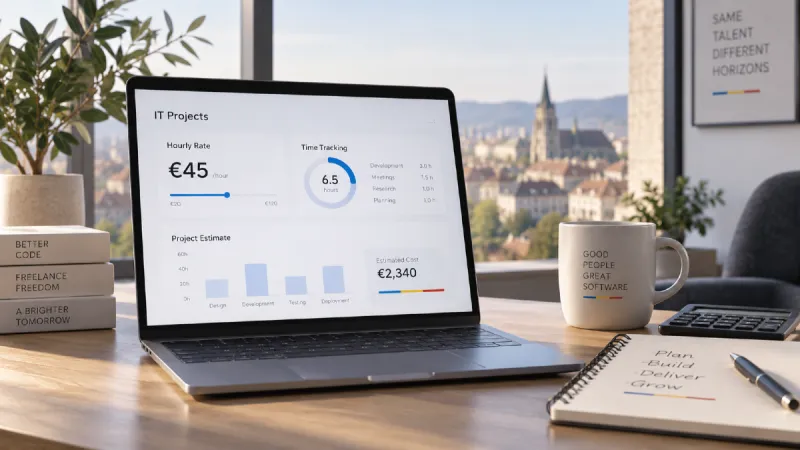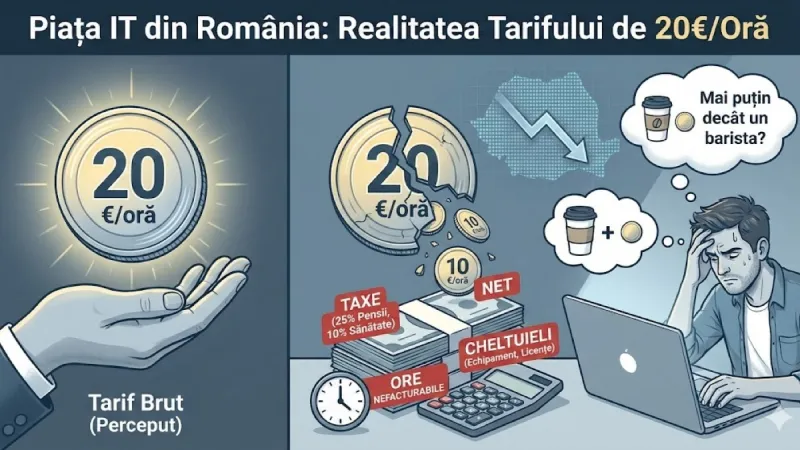
The brutal calculation of IT freelancing rates: after taxes, expenses, and non-billable hours, out of 20 euros, only 10 remain in your pocket. We explain the painful mathematics of undervaluation and why Romania deserves rates of 30-70 euros per hour.
Every day, dozens of talented Romanian developers accept projects at 20 euros per hour, convincing themselves it is a decent rate. Within a few months, most come to regret this decision. Not because the work was too hard, but because they realize, too late, that they have been working almost for free. After paying taxes, equipment costs, and the time invested in administration, out of those 20 euros, you are left with barely 10-12 euros per hour in your pocket. Less than a barista makes in a Bucharest café.
The paradox is that these developers are no less competent than their colleagues in Poland or the Czech Republic who charge 40-50 euros per hour for the same work. Romania ranks third in Europe in the number of technology specialists and is considered one of the top ten destinations for IT outsourcing on the continent. The problem is not a lack of competence, but a lack of understanding regarding how to correctly evaluate and price one's own work.
The Painful Reality of the 20 Euro Rate
Let's do a simple, yet brutally honest calculation. A freelancer working for 20 euros per hour who manages to bill 1,400 hours a year earns a gross 28,000 euros. Sounds good, right? But let's see what happens to this money in reality.
Right from the start, the Romanian state asks you to contribute to the pension budget with 25 percent, which is 7,000 euros. Add another 10 percent for health, another 2,800 euros. Income tax is modest, only 280 euros for a micro-enterprise. But you also have to pay the accountant, software licenses, a new laptop every two years, internet, electricity, and workspace. Another 3,000 euros per year, on average. When you add it all up and subtract it from the 28,000 euros, you are left with exactly 14,920 euros in hand per year. Divide that by 1,400 hours and you get your real rate: 10.65 euros per hour.
And that assumes you managed to bill 1,400 hours. In reality, out of a year with 2,080 available work hours, you must subtract public holidays, vacation, days without projects, time spent looking for new clients, answering emails, learning new technologies, and handling administration. Experienced developers know that you can bill, at best, 65-70 percent of your time. The rest goes into necessary but unpaid activities.
What the Market Actually Says
Salaries in the Romanian IT industry have risen constantly in recent years. In 2024, the average net salary in the IT sector exceeded 11,000 RON per month, equivalent to approximately 2,200 euros. Of course, there are major differences based on experience and specialization. A junior developer with less than two years of experience earns between 6,000 and 8,000 RON net per month, i.e., between 1,200 and 1,600 euros. A mid-level developer, with two to five years of experience, reaches 8,000-13,000 RON net, between 1,600 and 2,600 euros. Seniors with over five years of experience can have salaries of 13,000-20,000 RON net or even more, meaning 2,600-4,000 euros monthly.
Premium specializations bring in even more money. A cloud architect, a blockchain expert, or an artificial intelligence specialist can earn 20-40 percent more than the average, sometimes reaching 82,000-84,000 dollars per year in large companies or on international projects.
On the international freelancing market, rates reflect this reality much better. A junior Romanian developer working directly with clients from Western Europe or the United States asks for between 20 and 30 euros per hour. A mid-level developer sits between 30 and 45 euros. Seniors and experts charge between 45 and 70 euros, and specialists in niche fields like machine learning or blockchain can reach 70-100 euros per hour or even more. These rates are not exaggerated. They represent the real market and offer Romanian developers a fair return, comparable to company salaries, but with the advantage of flexibility and independence.
How to Correctly Calculate Your Hourly Rate
The formula for a sustainable rate is more complex than it seems. You must start from the net salary you want to earn monthly and work backward. Let's say you are a mid-level developer and want to earn 10,000 RON net per month, which is 2,000 euros. Per year, that means 24,000 euros net in your pocket. That is your target.
Now add the costs. To a 24,000 euro net income, you must add approximately 35 percent for taxes and contributions, meaning another 8,400 euros. You also need at least 3,000 euros per year for business expenses: equipment, software, accountant, marketing. And it would be good to have a reserve for slower periods or professional development, say another 2,000 euros. In total, you reach a required 37,400 euros per year.
But how many hours can you realistically bill? From a full working year of 2,080 hours, subtract public holidays, about 104 hours. Subtract vacation, about 160 hours for 20 days. Time spent on administration, marketing, and professional training eats up another 400 hours. Roughly 1,416 billable hours remain per year, meaning 68 percent of the total. Divide the 37,400 euros by 1,416 hours and you get a minimum rate of 26.41 euros per hour. for safety and a margin for maneuvering, you should ask for 30-35 euros per hour.
This calculation is not theoretical speculation. It is the mathematical reality of sustainable freelancing. Below this level, you are effectively working at a loss or underpaying yourself.
Global Positioning and Competitive Advantage
Romania occupies a unique position in the global IT outsourcing market. Compared to developed markets, Romanian developers offer a discount of approximately 40 percent compared to American rates, while maintaining comparable technical standards. While a senior American developer can earn 84,000-140,000 dollars annually, the Romanian equivalent sits at 42,000-81,600 dollars—a significant difference that makes Romania extremely attractive for outsourcing, without compromising quality.
Our country ranks third in Europe in the number of employed technology specialists and is classified as a top ten destination for offshoring in Europe, offering an optimal balance between quality and cost. Romania ranks twelfth globally in the English Proficiency Index in 2024, offers a time zone perfectly compatible with Europe and America, and hosts a rapidly growing tech ecosystem with hundreds of startups and international companies.
The problem is not that Romanian developers aren't good enough for higher rates. The problem is that many of them do not understand the real math of freelancing and accept rates that, after all deductions, leave them with incomes below the level of a salaried junior. The international market is willing to pay fairly—you just need the courage to ask for what you deserve and be able to justify your value through professionalism and transparency.