When we think of defending a nation, standard images involve armored vehicles, fighter jets, and infantry. But for Estonia, a country with just 1.3 million inhabitants, the front line is no longer solely in muddy trenches, but in terminals, data centers, and network architecture. Nearly two decades after the massive DDoS attacks of 2007, the Baltic state has proven that well-written backend code, a decentralized infrastructure, and a prepared IT community can stop an offensive just as effectively as an anti-aircraft system.
Here is how Estonia managed to become a true cyber superpower and an absolute technological hub for NATO.
X-Road: Decentralized Architecture as a Defense Doctrine
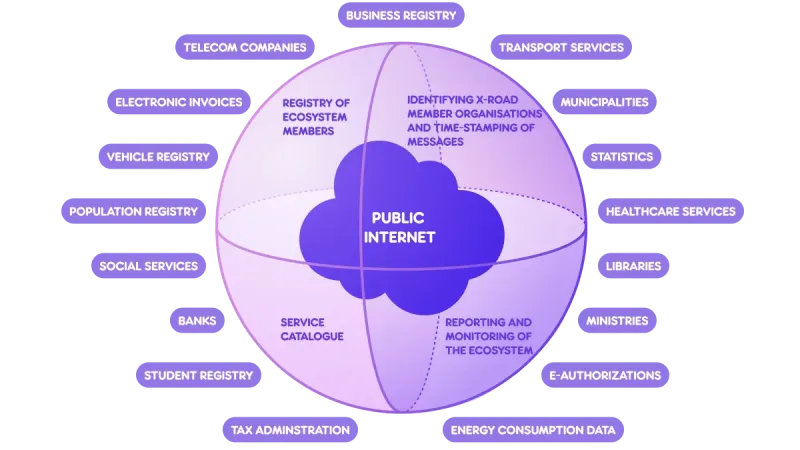
The foundation of Estonian resilience is not a magic firewall, but the very architecture of its government system. The entire state runs on a backbone called X-Road, an open-source data integration layer that allows public and private databases to communicate securely via encrypted APIs.
From a technical and military standpoint, X-Road eliminates the concept of a Single Point of Failure. There is no central government server that can be "taken down" to paralyze the state. Data is distributed, encrypted, and backed up by a network of "Data Embassies"—physical servers located in allied countries (such as Luxembourg) that store critical state-level backups. Even in the theoretical event of a total physical occupation, the Estonian state could run its services from the cloud.
Küberväejuhatus: When Sysadmins and Developers Become Special Forces
The Estonian military quickly understood that cybersecurity cannot be left solely to hardware equipment. In 2018, the Cyber Command (Küberväejuhatus) was officially established, a military branch dedicated exclusively to offensive and defensive operations in the digital space.
Here, a fascinating approach comes into play: integrating private-sector experts. Through the Cyber Defence Unit of the Defence League, full-stack developers, system engineers, network administrators, and IT security experts from commercial companies essentially become digital reservists. In a crisis, the state relies not only on career military personnel but on professionals who spend their lives in the terminal, managing complex databases or configuring high-performance Linux servers.
Automation, AI, and Real-Time Monitored Logs
In 2026, threats are asymmetric and constant. Estonia daily repels waves of cyber attacks coming from the east—from automated port scans and brute-force attempts to sophisticated phishing and malware campaigns. To handle this volume, the Estonian infrastructure relies heavily on automation.
Machine Learning-based algorithms analyze network traffic in real-time, identifying anomalies before they become security breaches. Redundancy is an art form, and the uptime of government services during massive attacks proves an impeccable resource management and rapid isolation of compromised nodes.
NATO Centre of Excellence: The "Silicon Valley" of Digital Defense
It is no coincidence that NATO chose Estonia's capital, Tallinn, to host the CCDCOE (Cooperative Cyber Defence Centre of Excellence). This is the alliance's brain when it comes to cyber doctrine.
This is where Locked Shields is held annually, the world's most complex Red Team vs. Blue Team cyber-defense exercise. Teams must defend simulated, yet highly realistic networks that control critical infrastructure (power grids, water purification systems, military communications) against sustained attacks, while maintaining services and reporting incidents.
Conclusion
The Estonian model demonstrates an essential paradigm of the 21st century: clean code, scalable network architecture, and rigorous systems administration are just as important to national security as the number of armored divisions. In an era where the first bullet fired in a major conflict will most likely be a corrupted data packet sent to a critical server, Estonia is already prepared on the front lines.