If you have ever owned a website, you have probably used WordPress. It is the platform that democratized the internet, promising that anyone can manage their content without knowing how to code.
Because of this, when I propose a custom web application built from scratch in Laravel, the client's first question (and biggest fear) is invariably this: "But how will I edit my texts? Will I have to call you for every single comma? I want the flexibility I had in WordPress!"
It is a perfectly valid fear. But it is based on outdated information. In 2026, custom web development no longer means rudimentary, hard-to-use control panels. Thanks to modern tools like Filament PHP (an admin framework for Laravel), my clients have absolute control over their websites, inside an interface that is cleaner, faster, and exponentially more powerful than anything WordPress can offer.
Here is why a custom-built Filament panel is a massive upgrade for your business compared to the traditional WordPress dashboard.
1. You Get Exactly What You Need. No Useless Buttons.
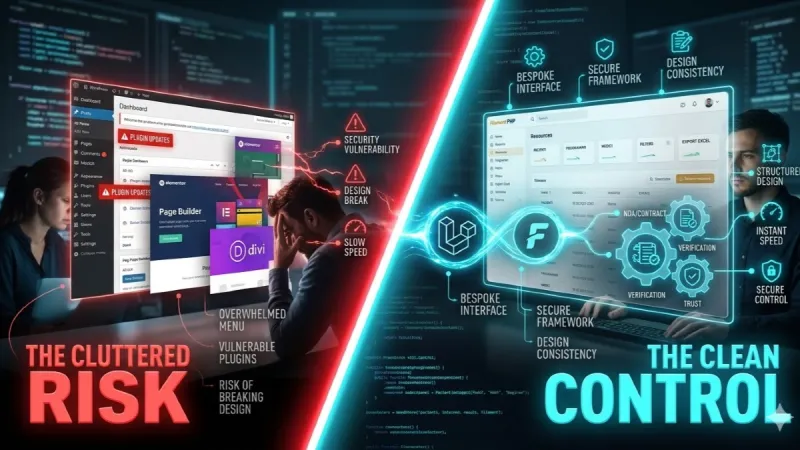
When you install WordPress, you get a generic dashboard. You have sections for "Posts", "Pages", "Comments", and "Tags". If your business is a medical clinic, you don't need "Posts"; you need "Patients", "Appointments", and "Doctors". To make WordPress "speak" the language of your business, you have to install clunky plugins (like ACF or CPT UI), and the sidebar menu turns into a chaotic mess of settings you never use.
The Filament Approach: Your admin panel is bespoke. If you manage a car fleet, your left-hand menu will contain exactly: Vehicles, Maintenance Logs, Drivers. No hidden settings, no ads for premium plugins. Just a clean, intuitive interface where your employees cannot get lost.
2. Total Content Control, ZERO Risk of Breaking the Design
The biggest problem with visual page builders in WordPress (like Elementor or Divi) is that they give you too much freedom. A well-intentioned employee might log in to change a paragraph, but accidentally shifts the margins, changes the brand font to red, or completely destroys the mobile alignment.
The Filament Approach: We use the concept of Structured Design (Builder Blocks). Instead of giving you a blank canvas that you can easily break, I build pre-designed "blocks" for you (e.g., Testimonial Block, Hero Block, Gallery Block). You simply choose their order, upload the photos, and type the text. The system automatically ensures that the typography, brand colors, and spacing remain flawless, including on mobile devices. You have infinite flexibility to build pages, but you physically cannot break the architect-approved design.
3. Handling Complex Relational Data
At its core, WordPress is a blogging platform. When you try to manage complex relational data (e.g., A Client has multiple Invoices, an Invoice has multiple Products, and a Product belongs to a specific Category), the platform starts to choke. You have to open 10 different tabs just to link the data together.
The Filament Approach: Filament shines when it comes to heavy data. You can edit an Invoice, the Products on it, and the Client's details all from the exact same page, using lightning-fast slide-overs (modals), dynamic tables with advanced filters, Excel exports, and instant global search. It delivers an Enterprise level of productivity that WordPress can only dream of.
4. Instant Speed and Ironclad Security
Have you ever logged into your WordPress dashboard and waited 4 to 5 seconds for a page to load because you had 30 plugins installed? Furthermore, each of those third-party plugins is a potential security vulnerability waiting to be exploited by hackers.
The Filament Approach: Built on a modern tech stack (Livewire, Tailwind CSS, Alpine.js), the Filament panel acts like a Single Page Application (SPA). This means pages transition instantly, without requiring a full browser refresh. Moreover, security is guaranteed by the Laravel framework itself (trusted by banks and major corporations worldwide). There are no shady third-party "plugins" to infect your server.
Conclusion
The myth that "a custom website means I can't manage it myself" is dead. By integrating the Filament admin panel into a Laravel application, you get the absolute best of both worlds: the performance, security, and scalability of custom-written code, combined with an elegant, ultra-fast admin interface perfectly tailored to your actual business needs.
Stop making compromises. Your business deserves a control panel built to help you be productive, not one you have to fight against every single day.
Are you afraid of losing control over your website if you move away from WordPress? As a Full-Stack Developer specializing in Laravel and Filament, I can build an admin system that you and your team will love from day one. Contact me and let's schedule a live demo!