In 2026, one question still comes up surprisingly often: “Does a business still need a website when Facebook, Instagram, TikTok, Google Business Profile, and now artificial intelligence already exist?”
The short answer is: not every business will fail without a website, but for most companies, having their own website remains one of the fundamental pieces of their digital infrastructure.
And there is an important difference between those two statements.
Some companies work extremely well through referrals alone. There are guesthouses and holiday cabins that find most of their customers almost exclusively through Facebook groups. There are B2B companies with a handful of large clients and recurring contracts that can generate millions in revenue without their website directly bringing in a single euro.
But the existence of such examples does not prove that websites have become obsolete. It simply proves that a company can have another customer acquisition engine that is strong enough on its own.
What Do Large Companies Do?
Eurostat data for 2025 is difficult to ignore.
Across the European Union, 79.02% of companies with at least 10 employees had their own website. The percentage increases with company size:
- 76.67% of small companies;
- 89.68% of medium-sized companies;
- 95.65% of large companies.
Romania, together with Bulgaria and Greece, is among the countries where the percentage remains below 60%.
In other words, large companies without websites certainly exist. Statistically, however, they are the exception rather than the dominant model.
And a website no longer simply means “Home – About Us – Contact.”
Eurostat data shows that 66.36% of European companies use their websites to display descriptions of products or services and price lists, 31.34% use them for recruitment, while 22.52% offer direct ordering, reservations, or booking functionality.
The 2026 Customer Does Their Own Research
The major change is not purely technological. It is behavioural.
A Gartner study published in 2026 found that 67% of B2B buyers prefer an experience in which they do not need to interact with a sales representative, while 45% had used AI during a recent purchase.
Another Gartner study gives an even clearer picture of the modern buyer:
70% prefer a fully digital self-service experience, while buyers use an average of seven different sources of information during the purchasing process.
This does not mean salespeople are disappearing.
Quite the opposite: 69% of buyers say they prefer to validate AI-generated information with a sales representative.
But the roles are changing.
Customers no longer necessarily contact a company first to find out who they are.
They research it first.
From Google to ChatGPT
There is another major shift that many businesses still underestimate: customers no longer search exclusively on Google.
In June 2026, Gartner reported that 47% of consumers and 60% of B2B buyers had consulted generative AI tools or chatbots during a recent purchasing decision.
That changes what “online presence” actually means.
A company needs to be discoverable, understandable, and verifiable not only by people, but also by systems that aggregate and interpret information from across the web.
A Facebook page can be part of that identity.
A LinkedIn profile can be part of it.
Google Business Profile, YouTube, marketplaces, and media coverage can all contribute.
But the website is the place where a company can publish official, structured information that it controls itself.
B2B Is Already Omnichannel
In 2026, McKinsey analysed almost 4,000 B2B decision-makers across 13 countries.
The result: buyers use an average of ten different channels throughout the purchasing journey.
At the same time, 71% of B2B companies already offer e-commerce, and among those that do, approximately one-third of their revenue comes through digital channels.
This means that the old debate — “Facebook or website?” — already starts from the wrong premise.
In 2026, the answer is usually:
Facebook + Google + website + email + marketplaces + social media + AI + human interaction.
These channels do not exclude one another.
They complement one another.
But a Website Will Not Save a Bad Business
The opposite myth also deserves to be challenged.
A company can spend €3,000, €10,000, or even €30,000 on a website and still get almost nothing in return.
If the product is weak, the pricing is wrong, the services are poor, there is no real demand, or the company does not know how to attract traffic, a spectacular redesign will not repair the underlying business model.
A website is infrastructure, not a business strategy.
A beautiful showroom cannot save a store that sells something nobody wants to buy.
In the same way, a website does not magically generate customers.
It needs SEO, content, distribution, advertising, referrals, email marketing, social media, or other mechanisms that bring people to it.
So, Is a Website Essential?
Not in an absolute sense.
A plumber who gets all their work through referrals can function without one.
A holiday cabin with 100% occupancy generated through Facebook groups can function without one.
A company with three corporate clients that already use its full production capacity can function without one.
But these examples answer the question:
“Can a business exist without a website?”
Of course it can.
The more useful question is:
“What does a business give up by not having a website?”
It gives up a communication channel it owns.
It gives up control over how its products and services are presented.
It gives up part of its visibility in search.
It gives up the ability to build its own long-term content assets.
It gives up opportunities for self-service, forms, reservations, automation, and potentially e-commerce.
And perhaps most importantly, it gives up a digital asset that it controls.
Facebook, TikTok, Instagram, and marketplaces are excellent distribution channels.
But their rules, algorithms, and even access to your account are controlled by someone else.
That is why I like a simple comparison:
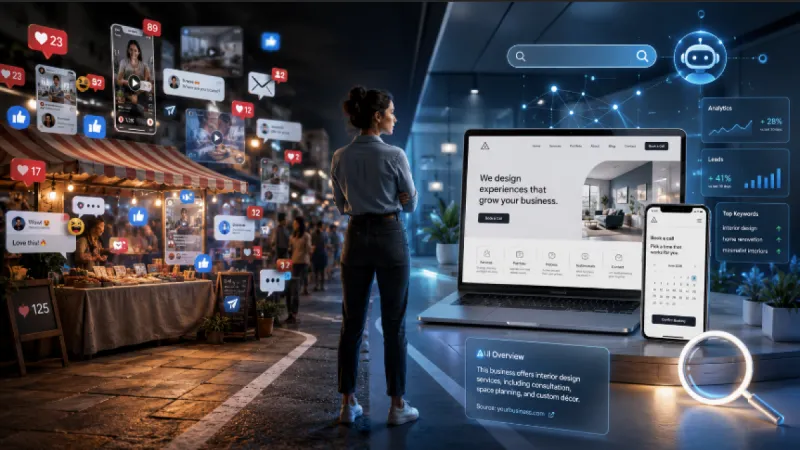
“If your business exists only on social media, you have a stall at the market. With your own website, you have your own showroom.”
That does not mean leaving the market.
Quite the opposite.
You use the market to bring people into your showroom.