If you are a member of any Facebook group, IT community, or freelancing hub, you've definitely seen this epidemic.
Every day, dozens of posts pop up looking like this:
- Anonymous Participant: "Looking for a programmer for an Uber-like app. Waiting for offers."
- Anonymous Participant: "I build cheap websites and automations. DM me."
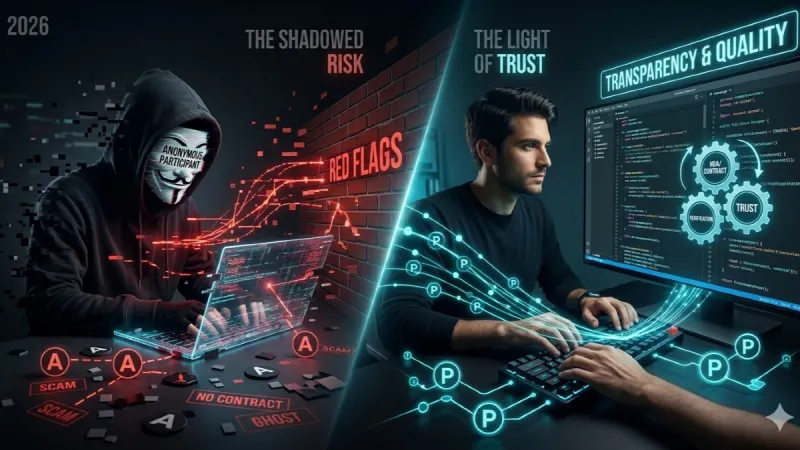
While the anonymous posting feature was created to protect people's identities in vulnerable situations, in the business and freelancing world, it has become the biggest, brightest Red Flag.
As a Full-Stack Developer working with clients worldwide, here is why I instantly reject any interaction with online "ghosts" and why you should too.
1. The Anonymous Client: Why Good Developers Will Ignore You
Many early-stage entrepreneurs believe that posting anonymously protects their "million-dollar idea" from being stolen. Or maybe they are hiding from their current employer. But here is what an anonymous post actually signals to a professional freelancer:
- "I don't have a real budget or a registered company": When you represent a serious business, you are proud to attach your name to it. Anonymity screams speculative project.
- Trust Issues: An IT collaboration involves contracts, NDAs (Non-Disclosure Agreements), invoicing, and intellectual property transfers. You can't sign a contract with a shadow. If you don't trust me enough to show your face upfront, why should I trust that you will actually pay me in the end?
- Reverse Natural Selection: Top-tier developers ignore anonymous posts because they already have serious clients. The only people who will reply to your hidden post are usually desperate freelancers, beginners, or scammers hoping to grab a quick upfront deposit.
2. The Anonymous Freelancer: How You Are Sabotaging Your Own Career
On the other side of the barricade, we have programmers, designers, or marketers offering their services from fake accounts, without a clear profile picture, or using the anonymous posting feature.
If you do this, you are single-handedly destroying your chances of landing premium clients. Here is why:
- In freelancing, you don't sell code; you sell Trust: The client gives you access to their servers, their database, and their customers' credit cards. If you hide behind an alias, why would they risk their business by handing you the keys to the kingdom?
- Lack of Accountability: An anonymous freelancer can disappear tomorrow. They can delete their account and leave the client with a broken website and stolen money. Without an assumed identity (a real LinkedIn profile, a portfolio on your own domain), you have zero public accountability.
- Destroying Your Personal Brand: In 2026, your digital reputation is your most valuable asset. Every successful project should be tied to your name. When you work in the shadows, you permanently remain a cheap, replaceable executor—one that can easily be swapped out for AI or a cheaper coder from another continent.
The Real Transaction: Transparency as a Quality Filter
The best way to filter out toxic clients and unreliable freelancers is radical transparency.
When a client puts their real name and company details in a post, it proves they are ready to invest time and resources. When a freelancer replies from their official profile, showcasing a clear portfolio (e.g., yourname.com), it demonstrates expertise and confidence.
Real business is done between real people. Any successful IT project—whether it's a SaaS platform in Laravel, a complex Python automation, or a scalable architecture on VPS servers—relies on open communication. You can't debug code at 2 AM or brainstorm software architecture with an "Anonymous" entity.
Conclusion
Stop looking for or offering services "in the dark." If your idea is so fragile that it will collapse just by letting someone know who is writing the code, it’s probably not a good idea. If you are a freelancer afraid to stand behind your portfolio, you probably have more to learn before asking for money.
Step into the light. Own your expertise and your projects. That is where long-term collaborations, serious budgets, and high-quality code reside.
Are you a serious entrepreneur or business looking for a transparent technical partner, not just a code-monkey hiding behind an avatar? As a Full-Stack Developer, I place a massive emphasis on trust, accountable communication, and clean architecture. No fake profiles, no surprises. Let's connect and talk about your project!