As a Full-Stack Developer, I often hear this phrase during initial discussions with potential clients: "I looked through your portfolio. Website X works perfectly, but honestly... I really don't like the colors and the visual style."
My answer is always the same, accompanied by a smile: "I'm glad you don't. It wasn't built for you."
There is a massive misconception in the IT and Web Development market: the idea that a programmer's portfolio reflects their personal taste and design style. Nothing could be further from the truth. Here is why a diverse (and sometimes visually quirky) portfolio is actually the biggest sign of professionalism you can find in a developer.
1. A Professional Leaves Their Ego at the Door
A junior programmer will always try to impose their own tastes. They will use their favorite theme, their favorite fonts, and the animations they personally like. The result? Every single website in their portfolio looks exactly the same.
An experienced developer does the exact opposite. When a client comes in and says: "I want my real estate website to have a bright red background with gold text," a professional will do two things:
- They will provide technical and UX (User Experience) consulting, explaining why that specific contrast might strain the visitors' eyes.
- If the client insists because "that's what my brand looks like and that's what I want," the programmer will write the code and deliver exactly that bright red background with gold text, perfectly executed on a technical level.
The final website reflects the vision, tastes, and identity of the client, not the programmer.
2. Tastes are Unique, Quality Code is Universal
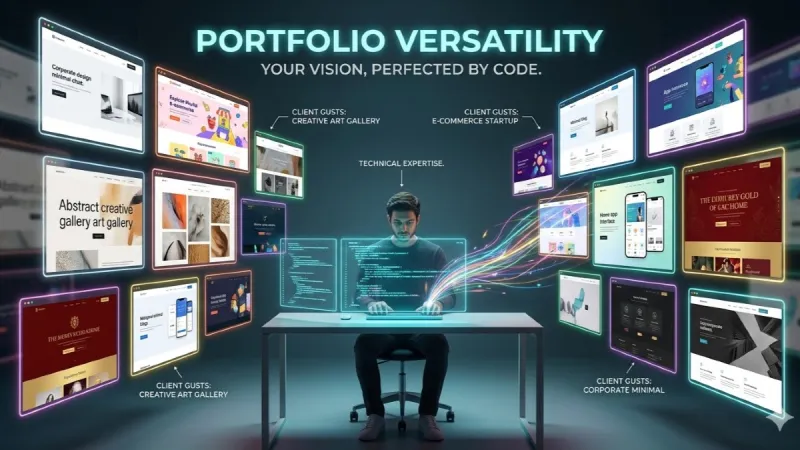
Every business has its own target audience. A website for a corporate law firm will be sober, minimalist, with lots of whitespace and serif fonts. A website for a private kindergarten will be explosive, full of pastel colors, rounded shapes, and playful animations.
When you look at a developer's portfolio, don't look at the colors or the chosen photos. Those are subjective. The portfolio doesn't prove what the programmer likes to look at; it proves their ability to adapt to any requirement. It demonstrates flexibility. It proves they can listen to a business requirement and turn it into reality, no matter how specific or unusual the requested aesthetics are.
3. What Should You Actually Look For in an IT Portfolio?
If the design is dictated by past clients, how can you tell if the programmer in front of you is actually any good? Evaluate the things that are 100% under their control:
- Load Speed (Performance): Browse the websites in the portfolio. Do they load instantly? Do images appear quickly? (This is where you see the difference between clean code and a bloated template).
- Mobile Responsiveness: Open the sites on your phone. Does the menu break? Does the text overflow off the screen? A good developer ensures the site is technically flawless on any screen, regardless of the colors requested by the client.
- Functionality (Bug-Free): Click the buttons, use the filters, open the contact forms. Does everything work smoothly and without errors? That is the signature of a true software architect.
Conclusion
Don't look for a programmer whose portfolio perfectly aligns with your artistic tastes. The chances of finding someone who has only ever had clients identical to you are zero.
Look for a technical partner who listens. A professional who asks you what you want your brand to look like, who respects your vision, and who has the technical expertise to build the unseen foundation (the code) to support that vision online.
Do you have a clear vision of what your business should look like online, but need someone capable of building it technically? As a Full-Stack Developer, my job isn't to dictate your design, but to turn your ideas into fast, secure, and perfectly functional platforms. Let's talk about how YOU want your next website to look!