Auto Daune: AI-Assisted Insurance Claims Automation
01 The Challenge
Managing a vehicle insurance claim requires accident victims and intermediary agencies to coordinate a large number of documents, messages, personal details, vehicle information, and communications with insurers.
In a conventional workflow, these elements arrive through different channels and must be reviewed, transcribed, organized, and forwarded manually. This creates several operational bottlenecks:
- Fragmented document intake: identity documents, vehicle documents, insurance policies, accident reports, bank details, and supporting files can arrive at different times and in different formats.
- Repetitive manual transcription: agents must repeatedly copy sensitive information such as names, identification details, vehicle registration numbers, VINs, insurer information, and IBANs.
- Inconsistent source material: users frequently submit mobile photographs, rotated images, incomplete files, or multi-page PDF documents that are difficult to process consistently.
- Incomplete claim files: missing documents and missing information generate repeated follow-up conversations and delay preparation of the claim package.
- Unstructured insurer communication: multiple short client messages can become multiple insurer emails, making the correspondence difficult to follow and increasing administrative noise.
- Need for human judgment: negotiations, compensation choices, exceptional cases, and legally sensitive decisions cannot be delegated blindly to an automated system.
The challenge was therefore not simply to add OCR to an upload form. The project required a persistent workflow capable of understanding the current stage of each claim, processing documents asynchronously, coordinating multiple communication channels, and transferring control safely to a human agent whenever judgment was required.
02 The Solution
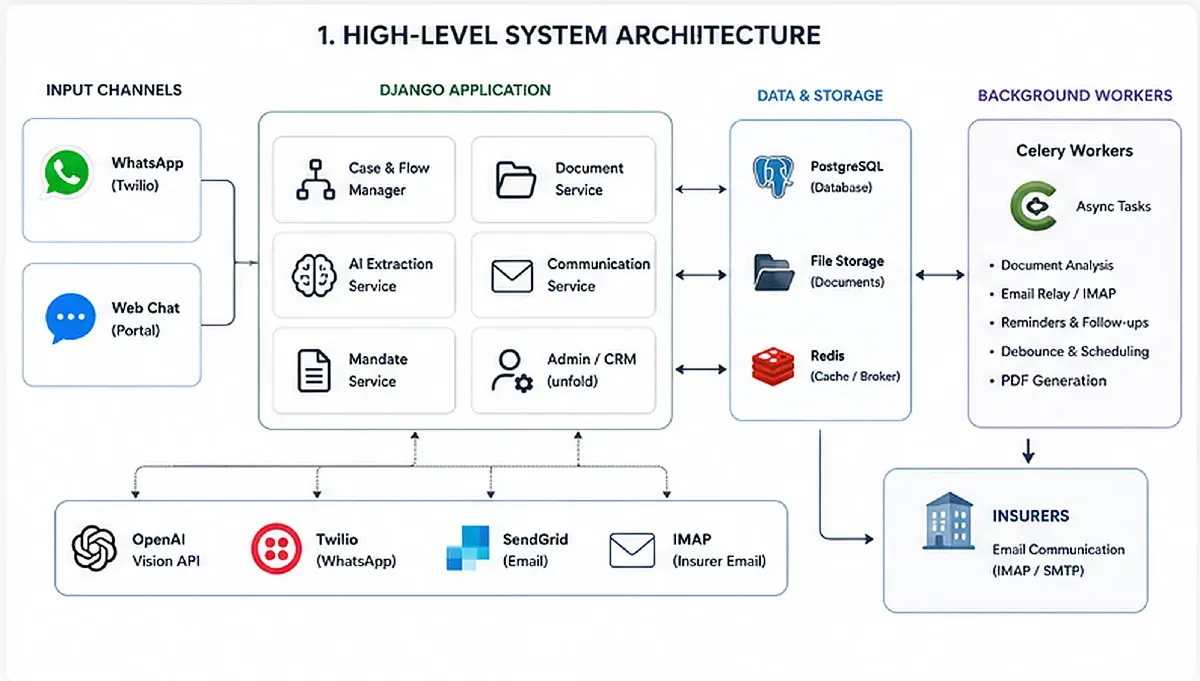
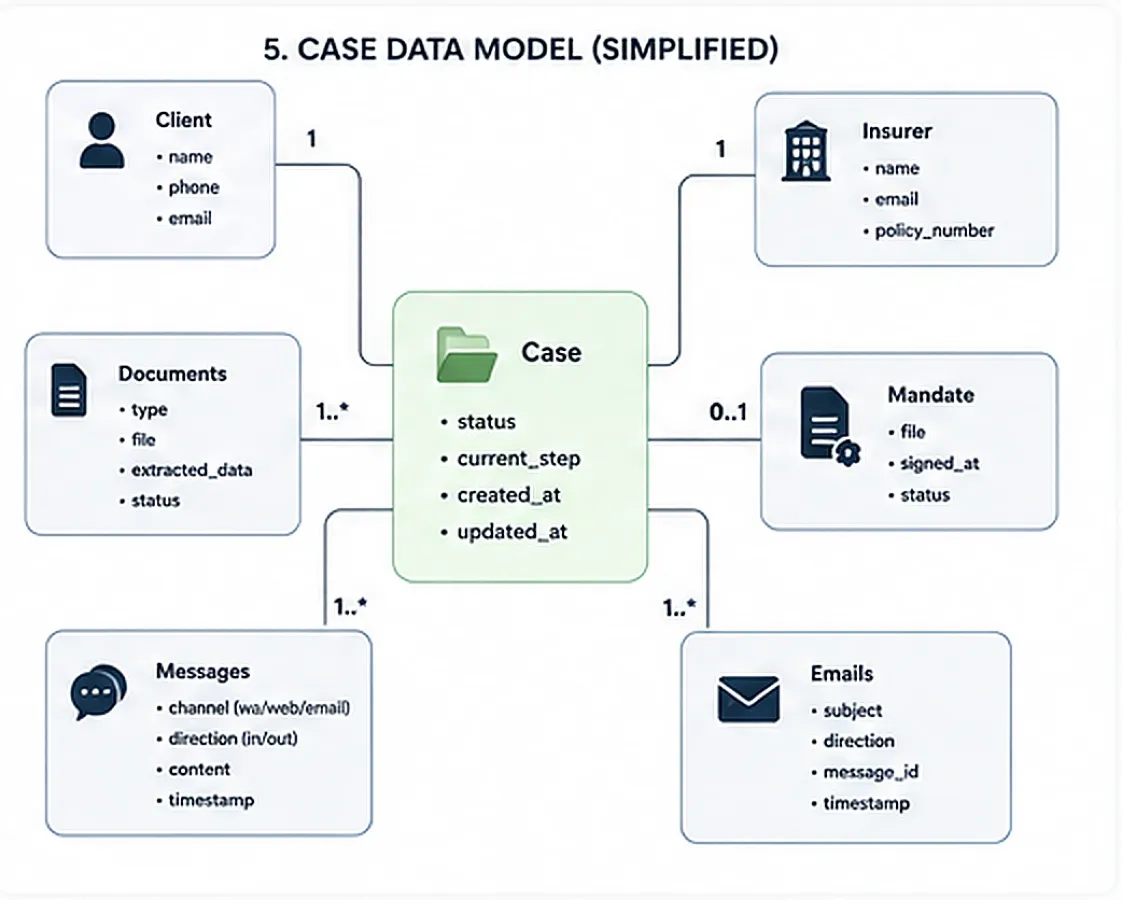
I designed and developed Auto Daune, a Django-based workflow automation platform that acts as a structured communication and processing layer between accident victims, the intermediary agency, and insurance companies.
The solution combines a persistent case state machine, AI-assisted document extraction, asynchronous background processing, omnichannel communication, and controlled human intervention.
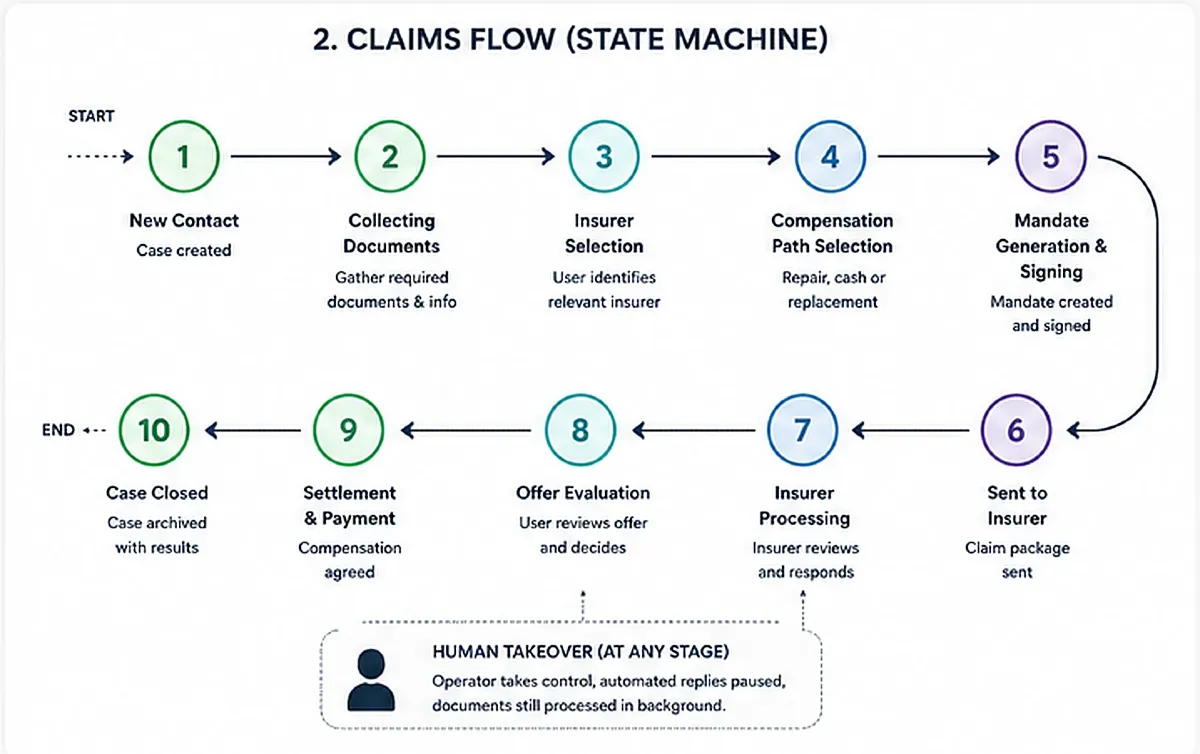
Persistent claims workflow
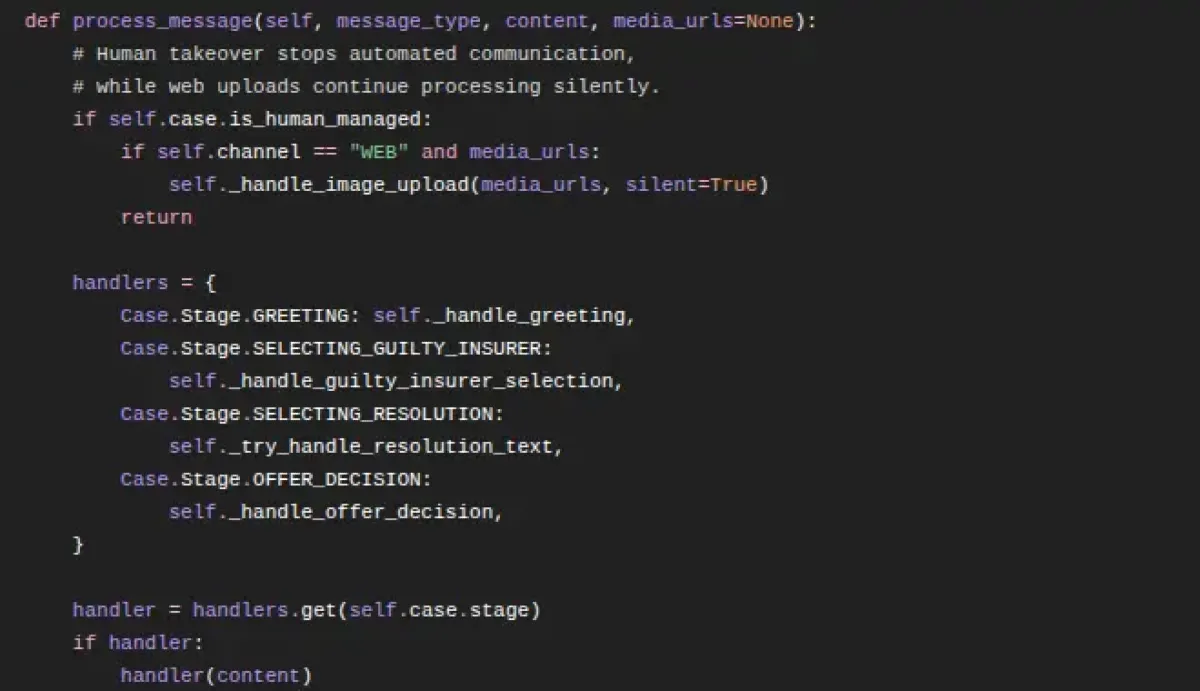
Every claim is represented by a persistent Case record. A dedicated FlowManager coordinates its progression through clearly defined stages, including initial contact, document collection, insurer selection, compensation-path selection, mandate signing, insurer processing, offer evaluation, and closure. 4
The application does not automatically decide who is responsible for the accident. The user identifies the relevant insurer, while the backend validates the workflow and advances the case only when the required information is available.
WhatsApp and web-chat intake
Users can interact with the system through WhatsApp, using Twilio, or through a custom web-chat interface. Both channels operate on the same case state, allowing messages and documents to become part of one consistent workflow rather than separate conversations.
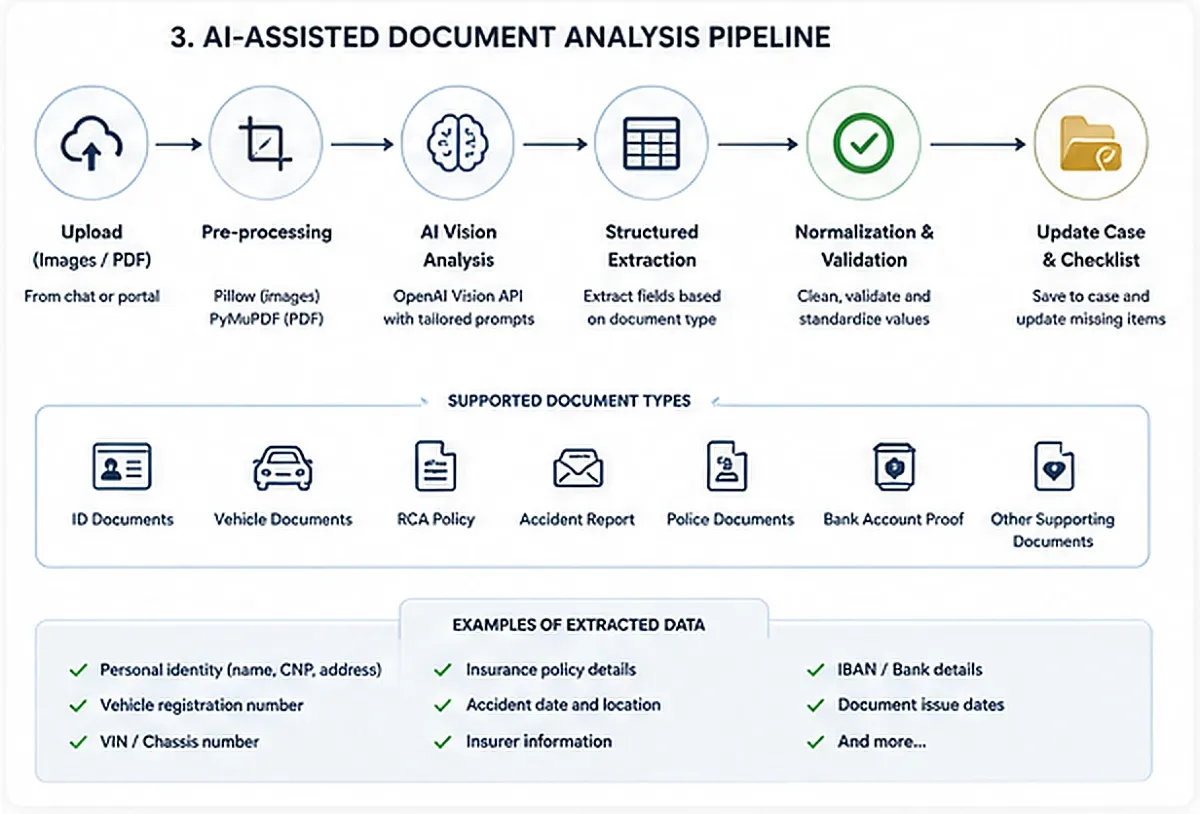
AI-assisted document analysis
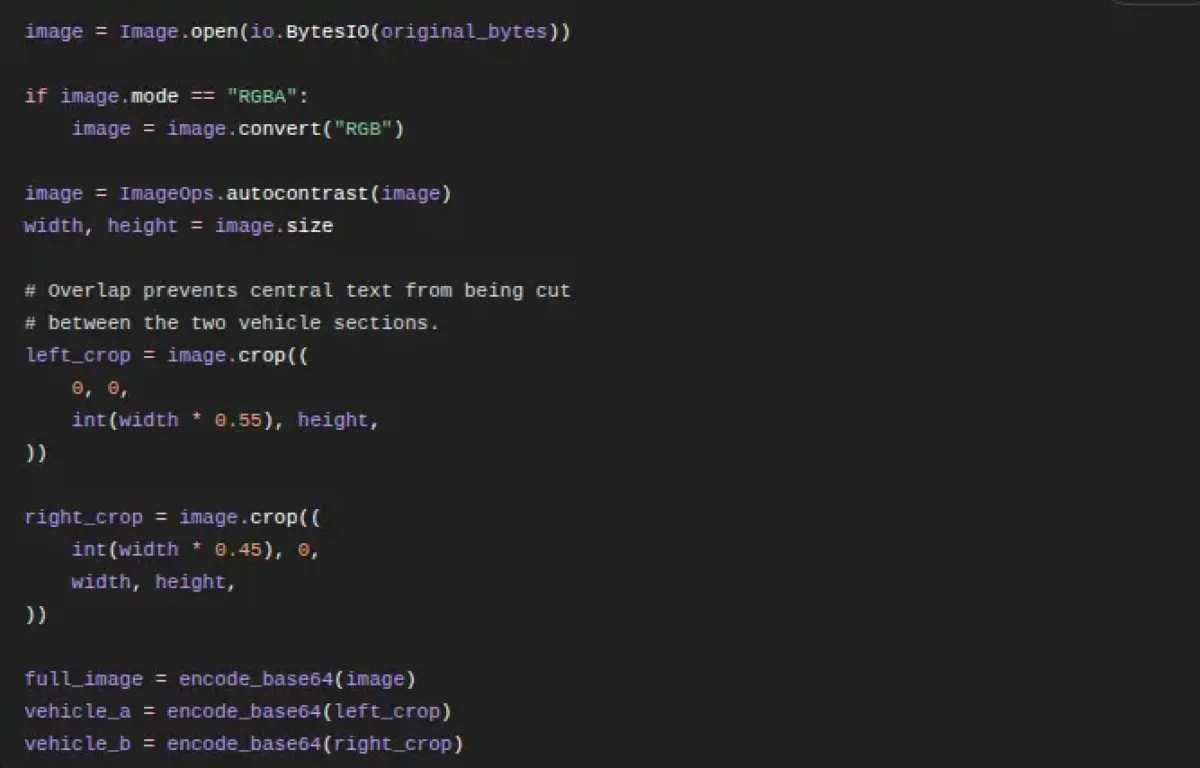
Uploaded images are prepared with Pillow, while supported PDF documents are rendered for analysis with PyMuPDF. The processed material is sent to a vision-capable AI model together with prompts tailored to the expected document types.
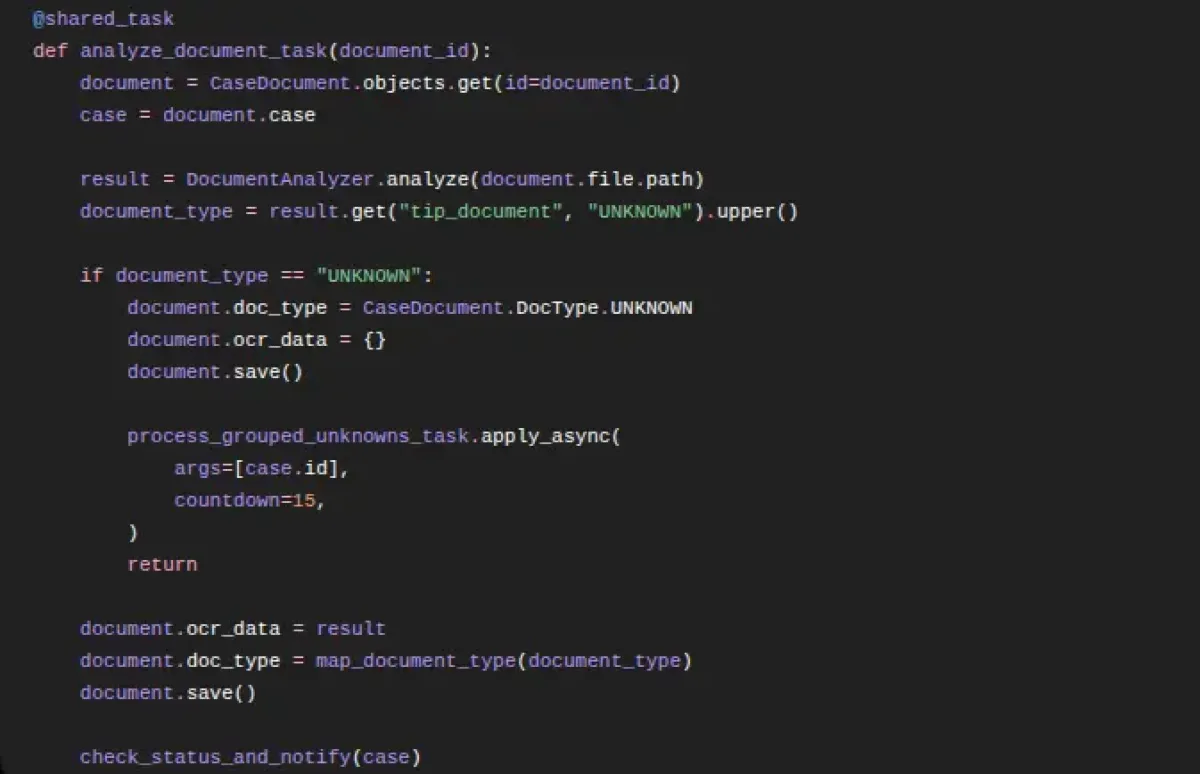
The extraction pipeline identifies the document category and returns structured information from items such as identity documents, vehicle documents, RCA policies, accident reports, police documents, and bankaccount evidence.
Extracted values are normalized before they update the claim. Registration numbers, VIN-related data, IBANs, and other fields are cleaned and validated according to their expected format. Missing or uncertain data does not automatically become accepted case information.
Multi-image and document grouping
When a document cannot be identified from a single image, the system can temporarily group related uploads and perform a multi-image analysis. This supports documents that are divided across several photographs or pages instead of assuming every upload represents a complete document.
Asynchronous processing with Celery and Redis
Document analysis, email preparation, insurer-reply checks, reminders, and delayed communication tasks are executed by Celery workers using Redis as the message broker.
This separates resource-intensive processing from the user-facing request cycle and allows the chat interface to remain responsive while documents and communications are handled in the background.
Atomic database updates are used when background tasks modify claim status and document checklists, reducing the risk of conflicting updates when several files are processed close together.
Structured insurer correspondence
Once the required claim information is available, the platform can assemble the documents and prepare the initial insurer correspondence. 5
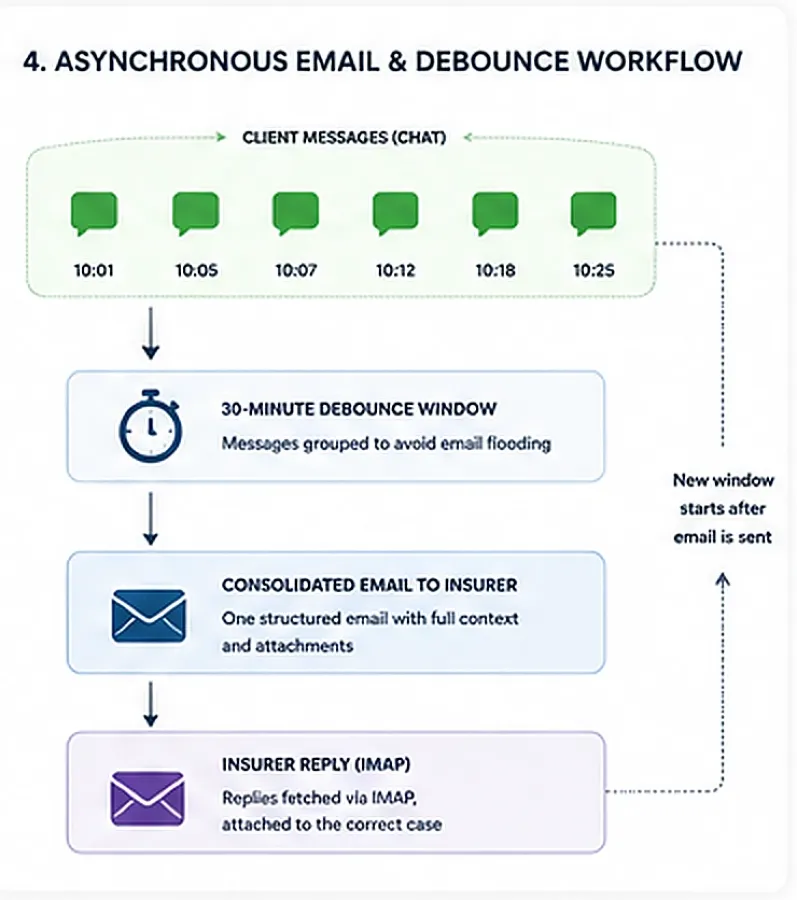
Incoming insurer replies are checked through IMAP, associated with the relevant case, and made available inside the claim workflow together with supported attachments.
A dedicated 30-minute debounce mechanism groups multiple client messages into one consolidated insurer email. This avoids sending a separate email for every short chat message and preserves a cleaner communication thread.
Mandate generation and signing workflow
The application uses collected case information to generate the mandate document required by the operational process and provides a workflow through which it can be reviewed and signed.
The case study describes the technical generation and signing workflow only. The legal validity and compliance requirements of the final document remain subject to the client’s legal review and applicable regulations.
Human-in-the-loop control
When an operator takes control of a case, the application marks it as human-managed and pauses normal automated replies. Document uploads can still be processed silently in the background, allowing the operator to retain the benefits of automation without competing with automated messages.
A custom administration and CRM interface gives the agency access to claim status, communications, uploaded documents, extracted data, and manual reply controls from one operational view.
03 Business Impact
Auto Daune transforms a fragmented, message-driven claims process into a structured digital workflow in which each document, extracted value, communication, and operational decision is associated with a persistent case.
The platform creates business value in several practical ways: 8
- Less repetitive administrative work: document classification, structured extraction, checklist updates, mandate preparation, and email assembly no longer depend entirely on manual handling.
- More consistent claim preparation: the workflow verifies which information and documents are available before advancing the case to the next stage.
- Cleaner insurer communication: client messages can be consolidated into structured email correspondence instead of generating a fragmented thread.
- A simpler claimant experience: users can submit documents and continue the process through familiar communication channels without needing to understand the agency’s internal administration.
- Operational visibility: administrators can review the case stage, extracted information, uploaded documents, and communication history from one interface.
- Controlled automation: deterministic backend rules manage the workflow while human operators retain authority over negotiations, exceptions, and sensitive decisions.
- Separation of interactive and intensive workloads: background workers process documents and communications without forcing users to wait for every operation to finish inside the web request.
- A reusable technical foundation: the state-machine and task-based architecture provides a foundation for adding new document types, communication channels, validation rules, and operational steps without replacing the entire system.
The result is not a fully autonomous claims decision-maker. It is a human-supervised automation platform that removes repetitive work, organizes complex information, and allows specialists to focus their attention on the situations that genuinely require professional judgment.
Project Gallery
Use the arrows, dots, keyboard, or swipe to explore.