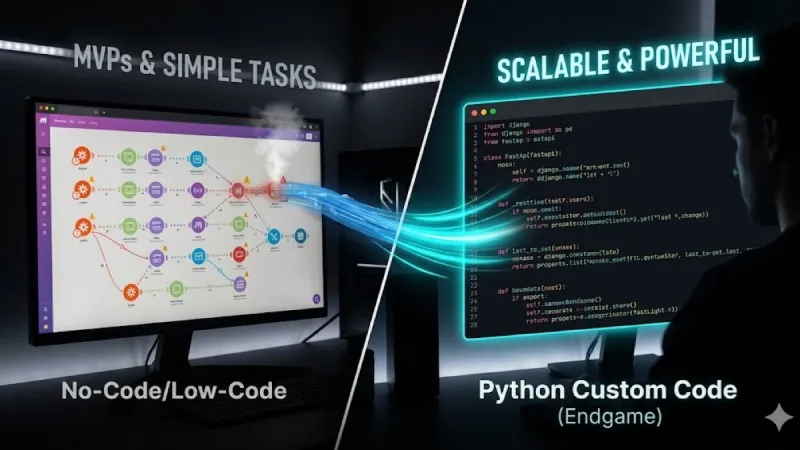
In 2026, everyone is talking about business automation. The "No-Code" promise tells us that you can connect dozens of apps just by dragging some lines across a screen.
And that is true... up to a point.
As a Full-Stack Developer, I’ve seen the exact same cycle repeat with dozens of clients: they start with Zapier for simplicity, move to Make.com when the logic gets more complex, flirt with n8n to cut down on costs, and ultimately realize a painful truth. When automation becomes the beating heart of your business, visual platforms turn from an advantage into a maintenance nightmare.
Here is why custom solutions built from scratch in Python (FastAPI, Django, Celery) are the true Endgame of automation.
1. Zapier and Make.com: The Illusion of Simplicity and the "Success Tax"
Platforms like Zapier and Make are fantastic for prototyping (MVPs) or trivial tasks (e.g., "When I get a Facebook lead, push it to a Google Sheet").
But when you try to build real business logic here, you hit two massive walls:
- Astronomical costs at scale: Zapier charges you per "Task". If your script needs to process 50,000 rows of data daily, you will end up paying thousands of dollars a month just for the privilege of moving data from point A to point B. It is a direct tax on your success.
- "Spaghetti" Logic: Try building a loop with 4 nested conditions (If/Else), error handling (Try/Catch), and database rollbacks in Make.com. What would take 15 lines of clean code in Python turns into a visual spiderweb that is impossible to read, test, or debug.
2. n8n: An Excellent Compromise, but with Structural Limitations
n8n solves the cost problem (since it's self-hosted, you only pay for your server) and even allows you to run small chunks of Python code directly inside its nodes.
However, at its core, n8n remains a visual "orchestrator" running on Node.js.
- You do not have fine-grained control over memory (RAM) when processing massive files.
- Code versioning (Git) and team collaboration (Code Reviews) on a giant JSON file (how n8n exports workflows) are difficult compared to a classic code repository.
- You are ultimately limited to the ecosystem and architecture they have designed.
3. Custom Solutions in Python (FastAPI / Django): Absolute Power
This is where we enter professional territory. When you write your automation in Python, using a modern framework (FastAPI for lightning-fast microservices or Django for complex database-driven systems) and a background task manager (Celery + Redis), the rules of the game change.
Here is why Python beats any visual platform:
- No Vendor Lock-in: The code is yours. You don't depend on platform pricing changes, and you don't have to wait for Zapier to add support for a new API you want to use. You have total control.
- Performance and Heavy Lifting: Python is the king of data processing. Want to analyze a million rows of financial data? In Zapier, it's impossible. In Python, you use the Pandas library and solve the problem in seconds, efficiently utilizing your server's CPU.
- Native AI and Machine Learning Integration: If you want to implement advanced AI logic (Autonomous Agents, RAG models, LangChain, PyTorch), No-Code platforms only offer basic API integrations. In a custom Python environment, you can run local LLMs, perform fine-tuning, and manipulate vectors directly in your code.
- State Management and Real Transactions (ACID): If a workflow fails at step 4 out of 5, what happens to the data that was already modified? In Python (via Django ORM or SQLAlchemy), you open a database transaction. If something crashes, you trigger an instant Rollback. Your data remains strictly consistent. Try guaranteeing that in a Zapier zap.
- Fixed and Predictable Costs: A $20/month VPS server running instances of FastAPI and Celery can execute millions of tasks a day without breaking a sweat.
Final Verdict: When Should You Write Code?
Nobody is saying you should reinvent the wheel. If you just want to send a Slack notification when someone fills out a form, use Make.com or n8n and save yourself some time.
But if:
- Automation is your core product (Core Business Logic),
- You are manipulating massive volumes of data or complex files,
- You need deep integration with Artificial Intelligence algorithms,
- Your monthly Zapier/Make bills have started looking like a mortgage payment,
...then it is time to make the switch to custom Python code. The initial development time is higher, but the long-term stability, security, zero marginal costs per execution, and architectural freedom are unmatched.
Has your business outgrown the limits of Zapier or Make? As a Full-Stack Developer, I can help you migrate your costly visual automations to a robust, secure, and lightning-fast Python-based architecture (FastAPI/Django). Let's discuss scaling your technical ecosystem!